The Apostolic Preaching (Acts 1-7)
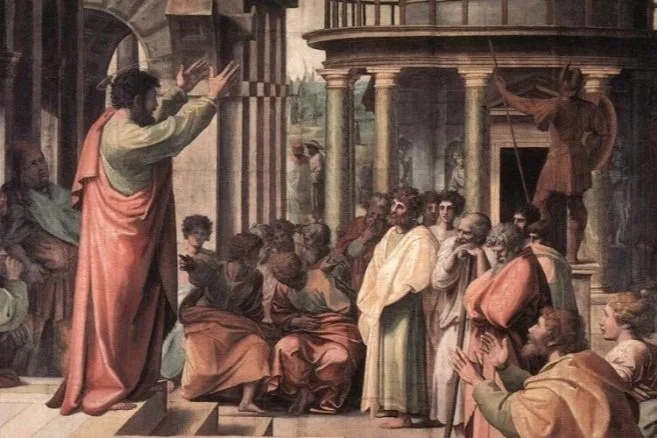
In the book of Acts, there are evangelistic speeches—primarily by Peter and Paul—that reveal the specific content of the apostolic preaching.
The first of these is in 2:14-36, after the Holy Spirit descended upon the disciples on the day of Pentecost. Verses 22-24, 32-33, and 36 are probably the heart of it:
Fellow Israelites, listen to this: Jesus of Nazareth was a man accredited by God to you by miracles, wonders and signs, which God did among you through him, as you yourselves know. This man was handed over to you by God’s deliberate plan and foreknowledge; and you, with the help of wicked men, put him to death by nailing him to the cross. But God raised him from the dead, freeing him from the agony of death, because it was impossible for death to keep its hold on him… God has raised this Jesus to life, and we are all witnesses of it. Exalted to the right hand of God, he has received from the Father the promised Holy Spirit and has poured out what you now see and hear… Therefore, let all Israel be assured of this: God has made this Jesus, whom you crucified, both Lord and Messiah.
Earlier, when Nicodemus visited Jesus at night (John 3), he said to him, “Rabbi, we know that you are a teacher come from God, for no one can do these signs that you do unless God is with him” (John 3:2). Peter used this same reasoning in his sermon in Acts 2—wonders, miracles, and signs performed by Jesus—to argue for His messiahship and lordship, and to explain the extraordinary manifestations of the Holy Spirit on Pentecost. The apostle accused his listeners of killing the Christ “by the hands of lawless men, crucifying him” (v. 23b) and proclaimed his resurrection and exaltation “at the right hand of God.” When they heard these things, “they were cut to the heart, and said to Peter and the rest of the apostles, ‘Brothers, what shall we do?’” (Acts 2:37). Peter told them, “Repent, and be baptized every one of you in the name of Jesus Christ for the forgiveness of your sins, and you will receive the gift of the Holy Spirit” (v. 38). And that day about three thousand people were baptized.
In Acts 3:13-26, there is a second discourse given on the occasion of the miraculous healing of a man lame from birth, who was sitting at the Temple gate called “Beautiful.” The substance of what Peter said there is as follows (vv. 13-16):
The God of Abraham, Isaac and Jacob, the God of our fathers, has glorified his servant Jesus. You handed him over to be killed, and you disowned him before Pilate, though he had decided to let him go. You disowned the Holy and Righteous One and asked that a murderer be released to you. You killed the author of life, but God raised him from the dead. We are witnesses of this. By faith in the name of Jesus, this man whom you see and know was made strong. It is Jesus’ name and the faith that comes through him that has completely healed him, as you can all see.
The main elements of this discourse are the same as in the previous one. Jesus is the glorified Son of God, whom the Jews handed over and denied before Pilate, preferring a murderer and killing the Author of Life, but God raised him from the dead, and it is through faith in him that the lame man sitting at the Temple gate called “Beautiful” was healed. As a conclusion to the discourse, Peter calls for repentance and conversion:
Repent, then, and turn to God, so that your sins may be wiped out, that times of refreshing may come from the presence of the Lord, and that he may send the Messiah, who has been appointed for you—even Jesus (3:19-20).
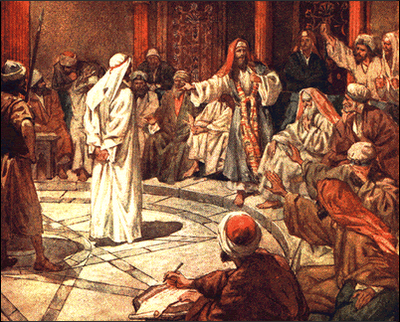
The third discourse (4:8-12) is a sequel to the previous one and was delivered before the members of the Sanhedrin, who asked Peter and John for an explanation of the healing of the lame man from birth. Peter reiterated that the miracle was performed “in the name of Jesus of Nazareth… whom you crucified and whom God raised from the dead” (v. 10), “the stone you builders rejected, which has become the cornerstone” (v. 11), and “salvation is found in no one else, for there is no other name under heaven given to mankind by which we must be saved” (v. 12).
A fourth discourse (5:27-32)—also before the Sanhedrin—was delivered after Peter and John were imprisoned and miraculously released. The Jewish authorities reaffirmed their prohibition against teaching in the name of Jesus, but the apostles’ response was firm in vv. 29-32:
Peter and the other apostles replied: “We must obey God rather than human beings! The God of our ancestors raised Jesus from the dead—whom you killed by hanging him on a cross. God exalted him to his own right hand as Prince and Savior that he might bring Israel to repentance and forgive their sins. We are witnesses of these things, and so is the Holy Spirit, whom God has given to those who obey him.”
The last discourse in this first part of Acts was delivered by Stephen—one of the seven men chosen for “the daily distribution to the widows,” according to Acts 6—also before the Sanhedrin (Acts 7). Stephen gave a historical account of God’s relationship with Israel, emphasizing the stubbornness and uncircumcised hearts of their ancestors, their rebellions, their lack of faith, their idolatry, and their infidelity, despite the wonders God performed among them, and then he accused his judges of having the same attitude and behavior as their ancestors. Stephen knew that his words in vv. 51-53 would cost him his life and thus became the first martyr of Christ:
You stiff-necked people! Your hearts and ears are still uncircumcised. You are just like your ancestors: You always resist the Holy Spirit! Was there ever a prophet your ancestors did not persecute? They even killed those who predicted the coming of the Righteous One. And now you have betrayed and murdered him, you who have received the law that was given through angels but have not obeyed it.
What can we learn? On the one hand, that people today need to hear the simple truth of the gospel. Christ came to the world and died for our sins, was resurrected on the third day and ascended to Heaven where He reigns as Lord. We must repent from our sins and embrace salvation by grace through faith. All preaching that is faithful to Scripture must include this statement in some way. On the other hand, the church of the 21st century must overcome the temptation to preach a message tailored to what the majority wants to hear or to what is “politically correct”—in spite of the consequences. The church is called to be the salt of the earth and the light of the world. But if the salt loses its ability to flavor, it is useless; and if the light is covered with a blanket, darkness will prevent the world from seeing the way to eternal life.