
The Question I Was Asking Wrong
It started with my wife Misty finding the Enneagram on Instagram.
She was convinced I was a Type 2. She would show me something on her phone and say, "See, that's you." I would then look at it and tell her it was the dumbest thing I had ever heard. We moved on.
Then I got to my first church, and my senior pastor handed me a book. "Check this out," he said. It was Ian Morgan Cron and Suzanne Stabile's The Road Back to You (2016). I started reading it mostly out of obligation. I figured I owed him that much.
Somewhere in those early pages, something started to shift.
The Wrong Question
I did what most people do when they first encounter the Enneagram: I started asking everyone around me things like “Do you do this?” I was pointing at behaviors, patterns, things I recognized on the surface. People would look at me a little sideways, and I could not figure out why my question was not landing.
It took me longer than I want to admit to understand what I was missing. The Enneagram is not interested in what you do. It is interested in why you do it. Those are completely different questions. One stays on the surface. The other goes somewhere uncomfortable.
When I finally started asking the right question, everything changed.
A Wound in Every Number
What struck me most as I kept reading was not the descriptions of each type. It was the sadness underneath them. Every number carries a wound. Every number is trying to solve something: meet a need, quiet a fear, fill a gap. Something that the world can offer only a temporary answer to. The world can soothe it for a while. But it cannot sustain. It cannot heal.
That is not a personality insight. That is a theological one.
And once I saw it that way, I could not stop seeing Scripture everywhere in the Enneagram. Not because the Enneagram is a biblical system, but because the Bible has always known what the Enneagram is only now helping people name. Every wound the Enneagram describes is a wound the gospel already addresses.
What I Saw When I Looked at My Own Number
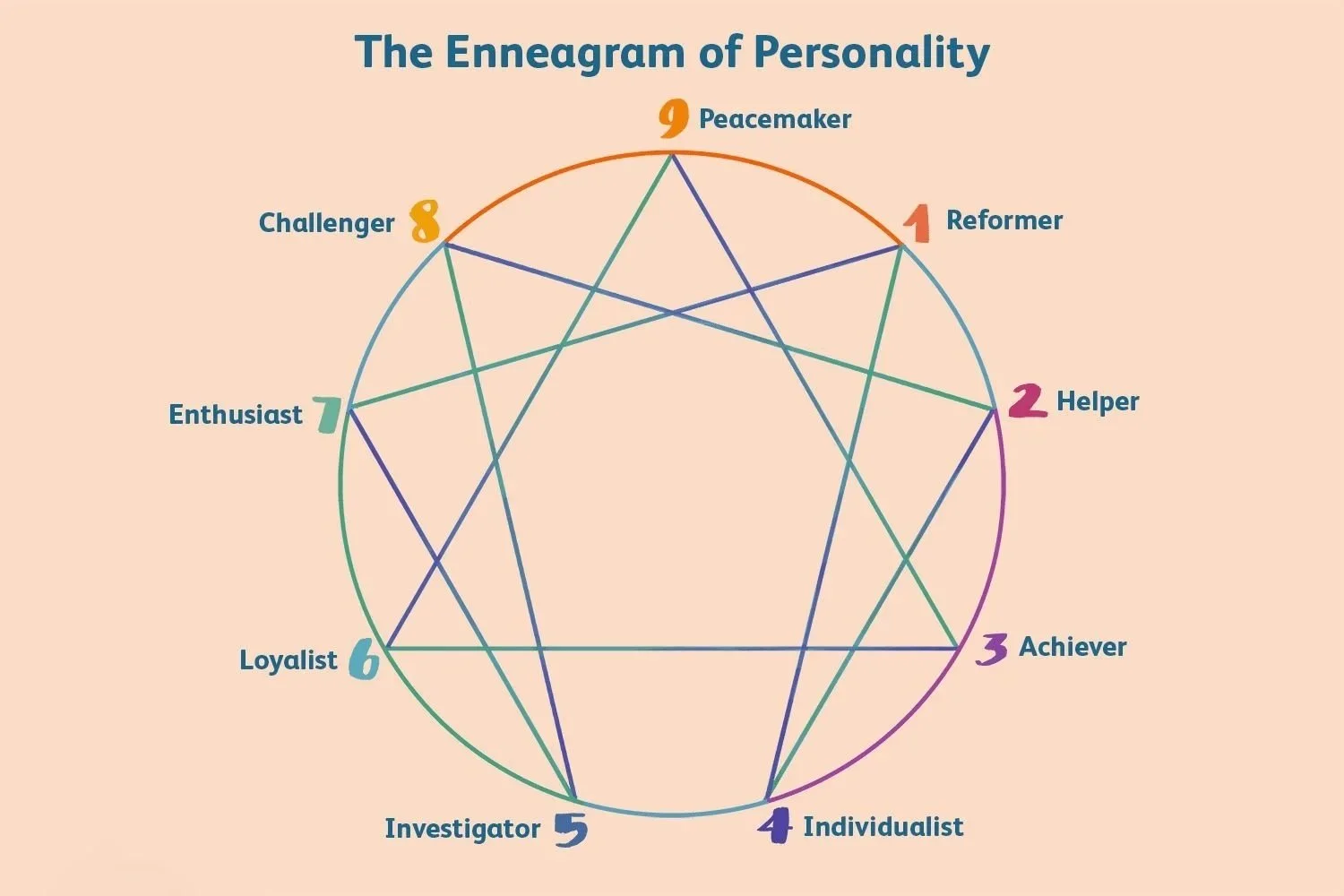
I am a Type 2. The Helper. And the wound underneath the helping is this: I do not feel loved unless I am doing something to earn it.
It sounds simple. It is not. It shapes everything. It means I give and give and give, not primarily from abundance, but from a quiet, unspoken fear that if I stop, the love stops too. I orient my entire life around others not because I am selfless, but because focusing on others means I do not have to face the terrifying question of whether I am enough on my own.
I saw myself in the story of Martha. Running around. Managing everything. Doing all the right things for all the slightly wrong reasons. And Jesus gently, firmly redirecting her attention to her sister sitting at his feet. Not helping. Not producing. Just present.
That image undid me a little.
The Confrontation and the Comfort
Paul's words in Gal. 1:10 hit me like a mirror: “Am I now trying to win the approval of human beings, or of God? Or am I trying to please people? If I were still trying to please people, I would not be a servant of Christ.” (NIV)
He was asking himself the same question I had never thought to ask myself. And he was naming the exact tension I had been living in without language for it.
But the verse that healed something in me was Zeph. 3:17: “The Lord your God is with you, he is mighty to save. He will take great delight in you, he will quiet you with his love, he will rejoice over you with singing.”
The whole Type 2 wound is the belief that love has to be earned. And here is God, not waiting to be impressed, not tallying up contributions, but delighting. Quieting. Singing. None of those verbs require anything from me. He is the one acting. I am the one being loved.
That verse does not just comfort the Type 2 wound. It dismantles it.
The Question I Ask Myself Now
I have a test I give myself when I feel that old pull to help, to fix, to show up in ways that will be noticed and appreciated. The question comes from Jesus in Matt. 6:3, the instruction about not letting your left hand know what your right hand is doing.
The question is simple: if nobody ever knew I did this, would I still do it?
If the answer is no, I need to sit at Jesus' feet before I go anywhere else.
That is what the Enneagram taught me. Not a set of behaviors to manage. Not a personality profile to display. A mirror that showed me a wound I had been carrying for years, and a door back to the only place where that wound actually heals.