

Findings from the 2025 Faith Communities Today Survey: Facility Usage and Activities
This is the second in a series of articles in which I share results from the Churches of Christ that participated in the 2025 Faith Communities Today (FACT) survey. The first article focused on church leadership. In this article, we continue by discussing how congregations use their facilities and the activities that they engage in.
The 2025 Faith Communities Today (FACT) survey is the latest in a series of national, interfaith surveys conducted since 2000. The FACT survey uses what they call a “key informant,” someone who is knowledgeable about the congregation, to answer questions about the congregation. The 2025 FACT survey was especially collected to assess trends among congregations that have emerged since the last survey in 2023. The 2025 FACT survey is also part of the Exploring the Pandemic Impact on Congregations (EPIC) project (https://www.covidreligionresearch.org/). For more information on the overall FACT survey effort and details on the 2025 data collection, visit Faith Communities Today.
A total of 80 Churches of Christ completed the survey from October to December of 2025. The responses are not representative of all Churches of Christ, but they do give us a sense of what some churches in our fellowship are experiencing.
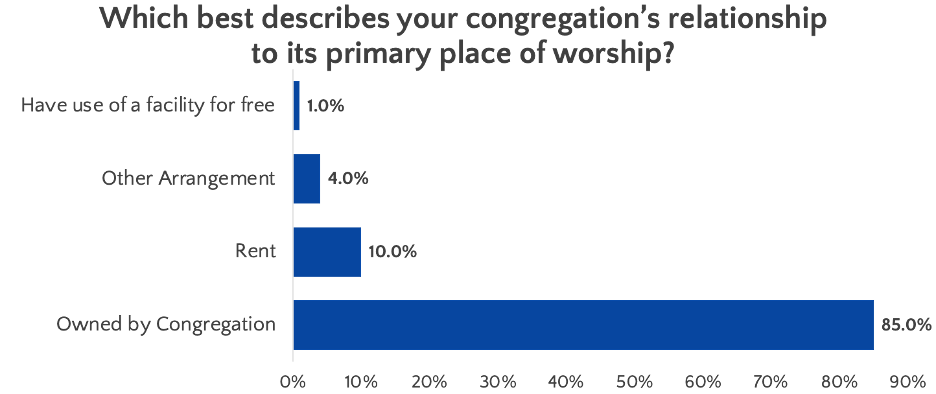
Let’s begin by looking at facilities. About 85% of respondents report owning the building where they meet. Additionally, a quarter of congregations share space with another organization.
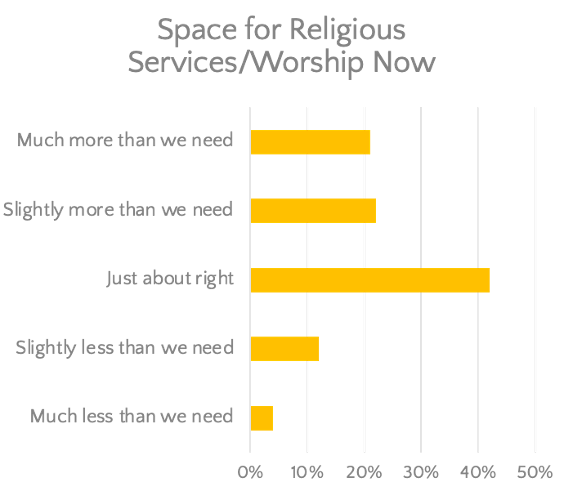
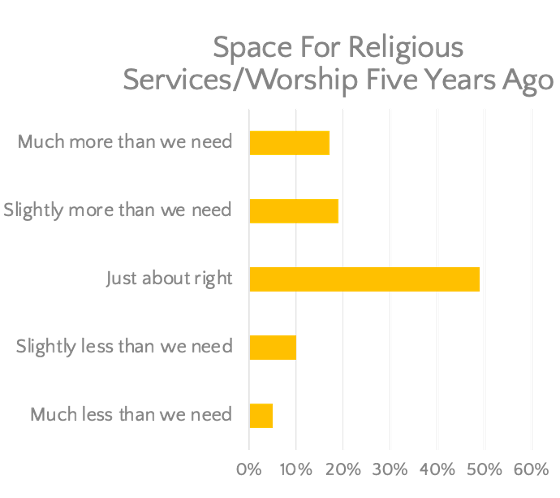
Given their ownership of buildings, how satisfied are respondents with the physical space? The FACT survey asked whether the space was adequate for religious services/worship five years ago and today. 36% of respondents report that five years ago they had slightly more or much more space than they needed, while 15% reported having slightly or much less space than they needed. In terms of the current moment, 43% report having more space than they need and 16% could use more space.
So, what are churches doing inside and outside of their buildings? The average (median) in-person attendance amongst churches that responded is 55, which is the same as the 2019 median attendance estimate. However, the average seating capacity for churches is 175.
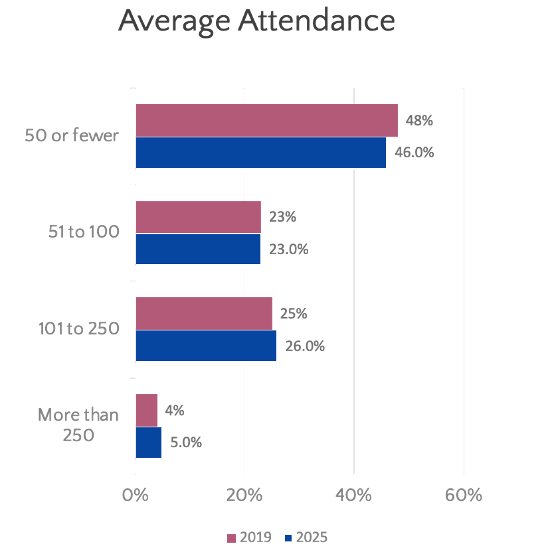
The COVID-19 pandemic pushed many churches to offer services virtually. 19% of the churches represented in the data offered virtual worship in 2019, and that has risen to 61% in 2025. The table below shows the average attendance in 2019 and today. You’ll see that the percentage of churches with 50 or fewer decreased (from 48% to 46%), and the percentage with more than 250 increased (from 4% to 5%). We see more detail on church growth and decline in the table below.
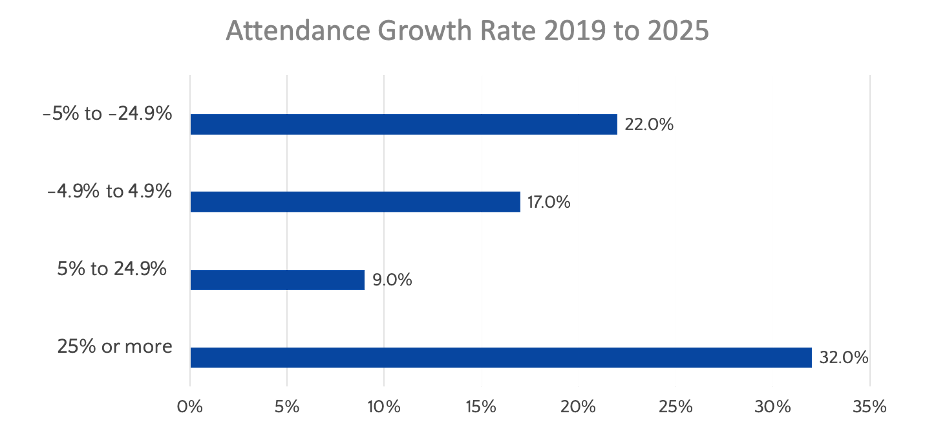
The FACT survey also asks respondents to estimate the percentage of regular attenders who are female (51.75%) and the average percentage of regular attenders who are college graduates (42.32%). In the 80 congregations participating in the survey, just over half of regular attenders also volunteer regularly (51.31%). About 1 in 5 regular attenders (21.87%) are new to the congregation in the last 5 years.
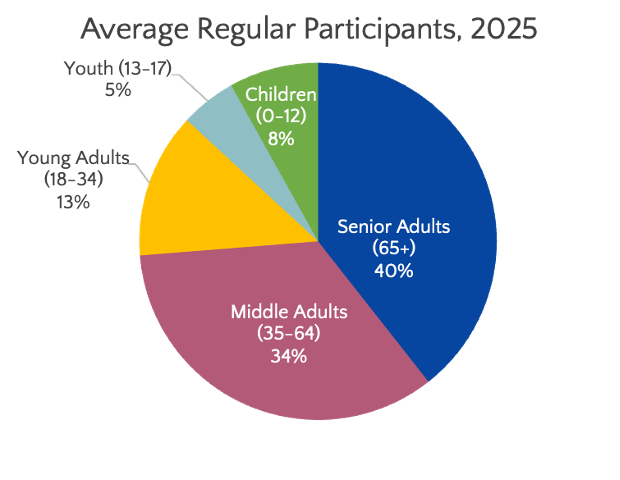
The survey also asked participants to estimate the average age of regular participants in 2025. We see in this pie chart (below) that 13% are under 18, while 40% of regular attenders are over 65.
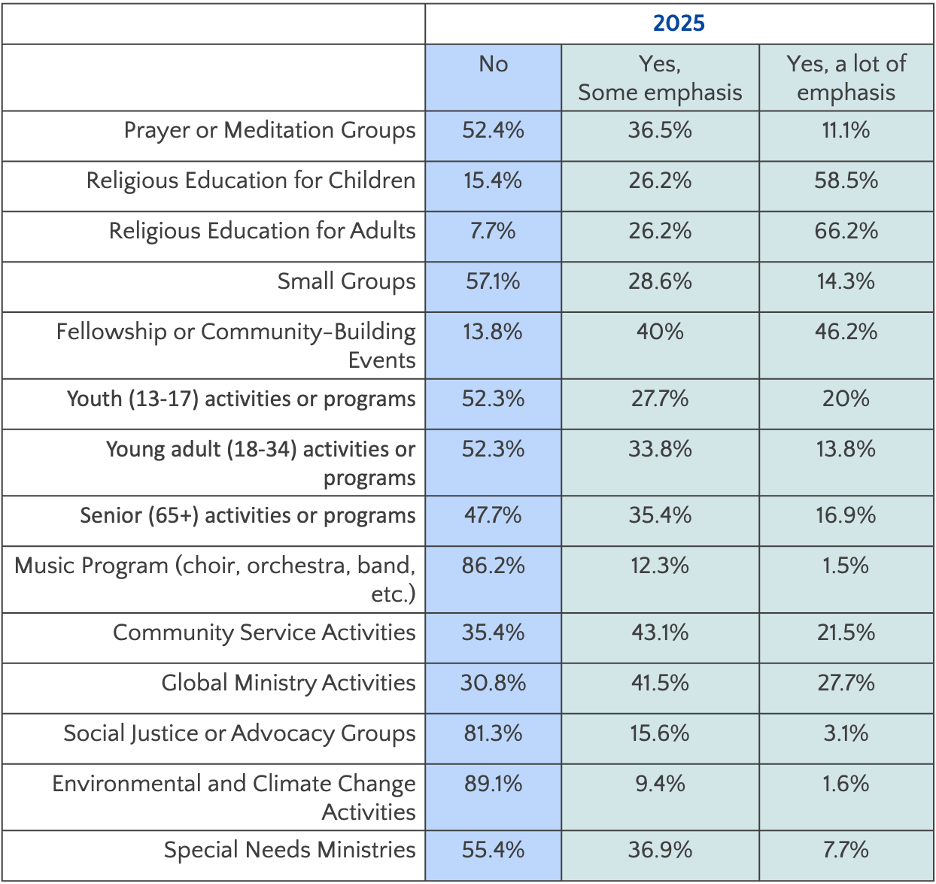
Lastly, respondents were asked about the programs that are offered by their church. The table below lists programs, asks whether each church offers it and, if so, whether it places some or a lot of emphasis on it. The programs most likely to be offered and emphasized are religious education for both children (84.6%) and adults (92.3%), fellowship or community-building events (86.2%), and global ministry activities (69.2%). The programs that are least likely to be offered are environmental and climate change activities (10%), music programs (13.8%), and social justice or advocacy groups (18.7%).
Respondents were also asked an open-ended question: “Which issues in society is your congregation most actively addressing? In what ways?” The most common responses were about homelessness, food and shelter insecurity, poverty, clothing, and racial, social, and climate justice.
Be on the lookout for the next article in this series in which we’ll take a look at mission and identity and conflict.