
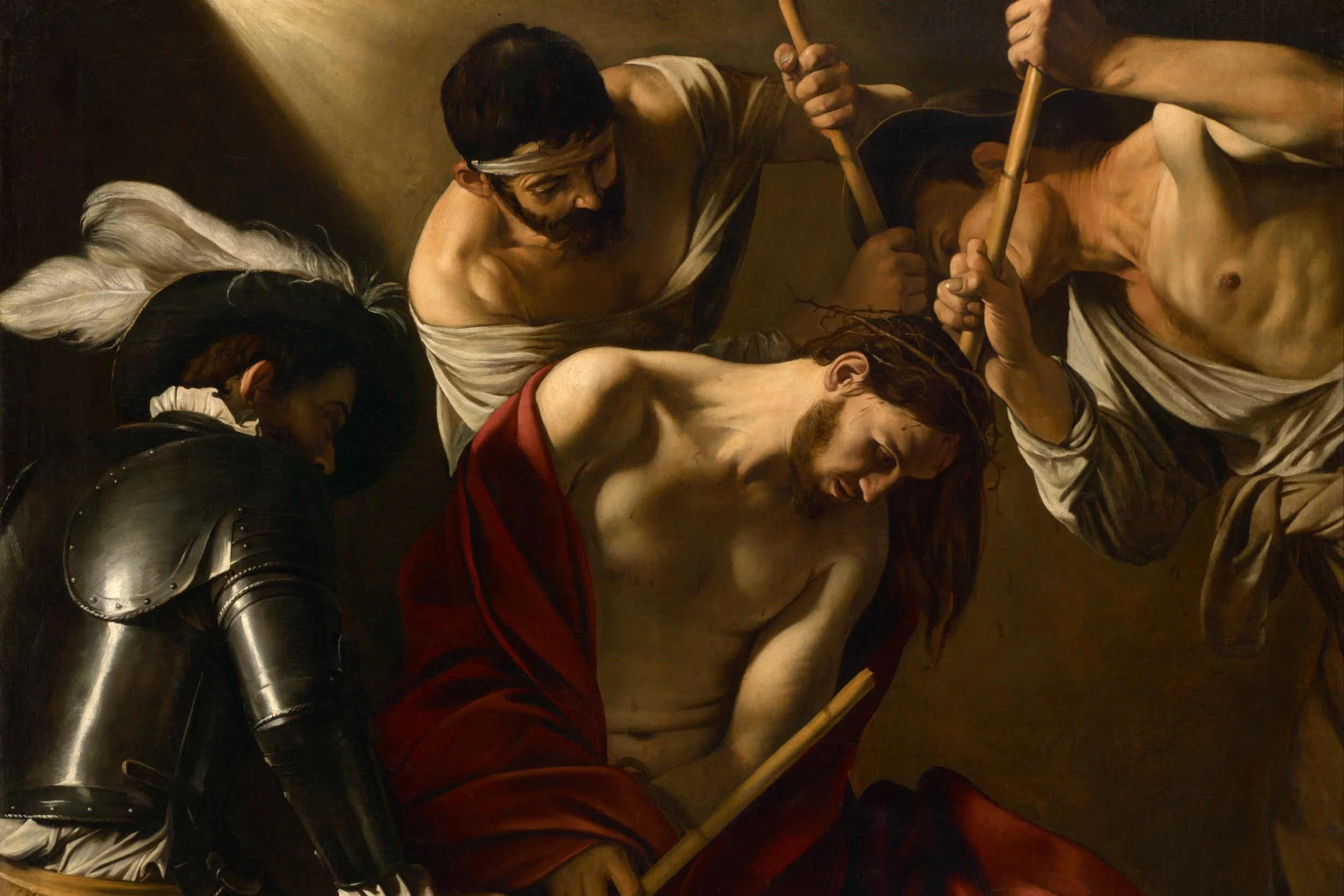
Pomp and Circumstance on the Way to the Cross
It’s graduation season, and chances are someone you love may be turning a tassel or tossing a funny-looking hat into the air this month. You may even be there to witness it.
In my experience, graduations are momentous, but not especially riveting occasions. (Unless they’re for kindergarteners, in which case they’re great theater!) Where I live in the land of enormous high schools (Dallas-Fort Worth), the graduation roll call — way up yonder, on a stage you need binoculars to see — can last a short eternity. If you’re like me, your mind wanders as the names roll on. You may wonder at the strangeness of the hoods the professors wear (which my recently hooded friend assures me cost a fortune). You may wonder why you never thought to legally change your loved one’s last name to start with “A.”
You may wonder at the robes, too: those long, drab, shapeless, monochromatic gowns that every grad dons on the big day. They’ve always seemed a bit incongruous to me with the joy of the occasion. I wish I could offer some insight into the tradition and symbolism of these robes. But instead, let me offer a place for your mind to wander next:
Remember Christ’s robe this graduation season. Help the grad in your life to remember them, too.
All four Gospels remember the robe that Jesus wore for at least a few moments in those final hours before he carried the cross. True, the remembrances vary slightly in hue: Mark and John picture Christ in royal purple (Mark 15:17; John 19:2–5); Matthew, in scarlet red (27:28). Luke, meanwhile, reflects not on color, but on quality; could this “elegant robe” be King Herod’s very own? (Luke 23:11). [1] Whatever the robe may have looked like exactly, in every Gospel, Jesus is fitted in kingly attire for a brief moment during his final hours. They even put a crown upon his head.
But the irony is thick and ugly. Though deserving of every praise and the highest throne, Christ is robed in attire wholly incongruous for the occasion. They “treated him with contempt and mocked him.” Herod and the soldiers “put an elegant robe on him and sent him back to Pilate” (Luke 23:11). They crowned him with thorns. Then, they crucified him.
Yet, somehow, in a twist of irony thick with beauty, God brought Christ’s majesty into view through the mockery and tragedy of the cross. Are we surprised? Scripture often shows God’s capacity to turn the world’s cruel ironies on their head. When God does this, Bible scholars sometimes call it “divine reversal.” God has a way of exalting the humble and humbling the exalted (Luke 18:14). Even more so, God has a way of drawing out the elegance of a life patterned after the humble, self-giving way of Jesus (Phil. 2:5–11).
I can think of no better lesson to instill in recent graduates. This month, the grads we love may be showered with well-deserved congratulations, generous gifts from loving church members, and maybe even a few sets of twin sheets for the college dorm. They are also likely to be flooded with advice and questions about what they plan to do next. After all, when graduates put on their graduation robes, they are stepping into a brand new chapter of their story, crossing over a meaningful threshold into a new stage of their life.
Christians can relate! In baptism, Christians enter a new chapter—we cross over a new threshold. The apostle Paul calls it being “clothed with Christ” (Gal. 3:27; Col. 3:12–14). It strikes me that this season in which the grads we love take up their graduation robes and cross over new thresholds could be an ideal time to reflect together on the robes we wear in Christ. We might be tempted to press grads to tell us all their future plans, but what matters more is that we pray for and encourage them to embrace the elegance of a life patterned after Christ.
Such a life may be incongruous with the ways of the world, or with one’s former ways before becoming a disciple (Col. 3:5–14). But that’s just the point. Our manner of life, as those who are clothed with Christ, should be different. Perhaps most of all, it should be characterized by the depth of our reverence for God. Remembering Christ’s robe helps us to find reverence because it shows us how God was willing to exchange honor for ridicule, even though God deserved every praise. In our self-aggrandizing culture, it is tempting to do just the opposite. Our culture is filled with models of self-exaltation, but short on models of reverence.
Today’s lack of reverence is not a new problem. In fact, one more ironic, divine reversal is woven into the biblical story of Christ’s robe. As mentioned above, in Luke’s Gospel, a member of the Herod dynasty (Antipas) is the one who mockingly dressed up Jesus in elegant robes, possibly his own (23:11). Luke, who also wrote Acts, describes how many years later, this same Herod’s grandson (Agrippa I) came to a gruesome demise — while wearing his elegant, royal robe. [2] (Warning: This is not a story for kindergarten graduates.) In Acts 12, Herod fashioned himself in shining, kingly robes and accepted praises befitting of God alone. Like his grandfather, Herod showed little regard for the God who was truly deserving of praise, little reverence for the majesty that only God is due. And it cost him (12:20–23). Herod learned the hard way that God exalts the humble and humbles the exalted. We can learn from his mistakes.
The temptation of our times (for most people, at least) is not to portray ourselves as God in a literal sense. It’s easy to live with a puffed-up sense of self and to lose touch with the reverence upon which all wisdom depends. But when we remember Christ’s robes and how he wore them, we discover a profound reason for reverence. And whatever season of life we may find ourselves in, remembering Christ’s robe may help us to embrace the elegant, if surprising, attire of those who are clothed with Christ.
[1] For a deeper dive into Luke’s account, see Mead, “Dressing Up Divine Reversal: A Narrative-Critical Reading of the Death of Herod in Acts 12:19–24b,” Restoration Quarterly 60.4 (2018), 227–234; O. Wesley Allen, Jr. The Death of Herod: The Narrative and Theological Function of Retribution in Luke-Acts, SBL Dissertation Series (Atlanta: Scholars Press, 1997).
[2] Josephus describes this robe as “a garment completely woven of silver,” Ant. 19.343-345.