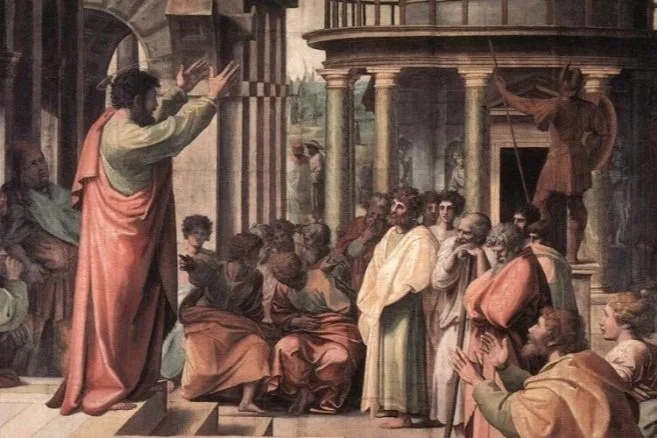

Christianity on the Move, Acts 8
Acts 8 describes the preaching of the gospel beyond Jerusalem. Those who had been scattered because of the persecution of the Jews orchestrated by Saul of Tarsus went everywhere preaching the gospel (8:4). Among them was Philip, who went to Samaria and established a church there. His preaching and the signs he performed impressed Simon, the magician of the city, who was also converted to Jesus Christ (8:13). Later, Philip preached and baptized an Ethiopian eunuch—a God-fearing Gentile who was returning home after participating in Jewish worship—and then “went on through all the towns until he reached Caesarea” (8:40). According to Acts 8:14, the apostles heard that Samaria had received the Word of God, and they sent Peter and John there to impart the Holy Spirit upon the new Christians. Verse 25 says that afterward they “returned to Jerusalem and preached the gospel in many Samaritan villages.”
The prominence of a leading evangelist like Philip, however, should not obscure the fact that the members of the church—each and every one of them—were the primary proclaimers of the gospel. They were the ones who told their neighbors what had happened to them, demonstrating it through their transformed lives. The church did not entrust this function to “professionals” who would do the work for them. No wonder the first-century church grew exponentially.
Michael Green comments in this regard:
“Gratitude, devotion, and dedication to the Lord who had rescued them and given them new life, that conviction of having been commissioned by Him and empowered by the Spirit to serve as heralds, messengers, and ambassadors, was the primary motivation for evangelism in the early church… Magnetized by this love, their lives could not help but reflect it, their lips could not help but speak of Him.” [1]
First-century Christians did not need a preacher to harangue them and make them feel guilty to evangelize. They did it as a natural expression of a heart grateful for the salvation received and dominated by the love of Christ. Fulfilling the Great Commission was not a burdensome chore for them, but a privilege.
Today, we must pray as a church that God will fill our hearts with gratitude for our salvation and love for the lost, so that we may see the opportunities He places before us each day to share the good news of salvation in Christ. We must also ask that He open our understanding to comprehend the reason for our existence as God's colony on Earth.
When Jesus said to his disciples in Matthew 5:13, “You are the salt of the earth,” he was not referring to an individual disciple but to the body of believers. The verb is plural. Collectively, the church is the salt of the earth. Individually, we are only a grain of salt, and a grain of salt by itself is not very useful. It doesn't season anything. It doesn't preserve anything. Salt must be used in handfuls to fulfill its function. The church is the salt of the earth as a community, and therefore, it must preach the gospel as a community.
The same can be said of the passage in Matthew 5:14-16, where Jesus tells his disciples that they are “the light of the world.” Again, they are light as a body, as a whole, as a community. When people see us gathered together and hear us sing, pray, read Scripture, and share our salvation, they are illuminated by the light of Christ that He has placed within us.
The first-century church understood this, and that is why the world of its time was seasoned and illuminated by Christ.
May God help us to do the same.