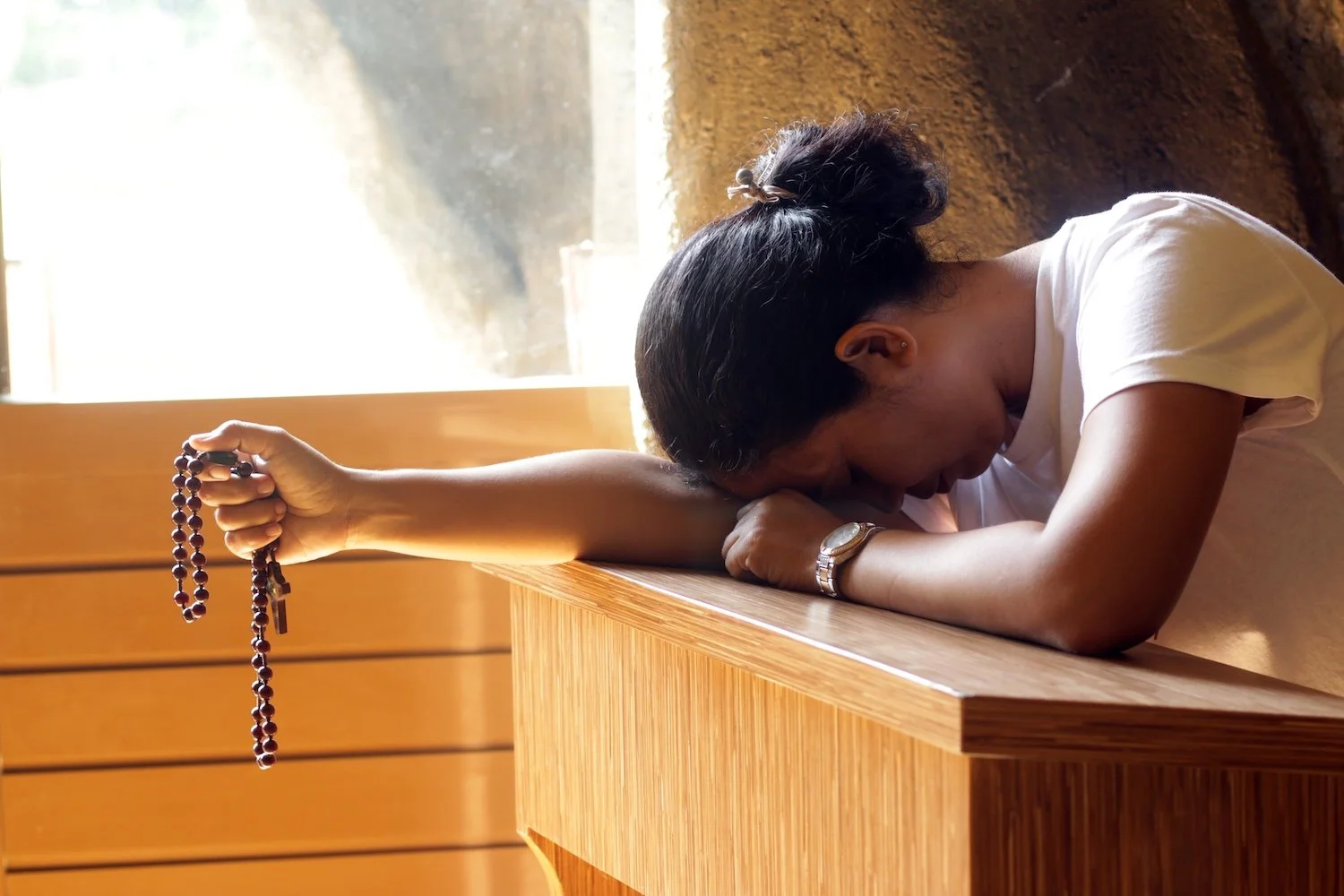

Nada Te Turbe: The Soul’s Dark Night
Welcome to part three of a four-part series on Habakkuk, written by Beth Ann Fisher. In case you missed it, here’s part one and part two.
Reflection Roundup reports from conversations couched in relationships. Here, readers will find boots-on-the-ground and “live from the field” items important to Christian leaders. As always, listening broadly draws together differing perspectives from which we can learn but with which we may not concur.
Habakkuk carried to God the personal and communal disorientation we all experience at times, an ancient outcry. This is a lost feeling which in the spiritual life can come in a few various yet common forms. This is the second in a series of posts unpacking forms that maybe people wish were not so common, while together we stand on the rampart watching. Here we wait for fresh awareness of God’s faithfulness.
The dark night of the soul: where and with whom did this spiritual concept originate? And for that matter, what is it?
In his original 16th-century work, the Spanish Christian mystic and Carmelite monk St. John of the Cross describes a state of abandonment that pushes a Christ follower to union with God in a loving way. A feeling of abandonment is loving, which sounds dichotomous to me. Let us be so bold as to consider, though, that it may be necessary and might even prove to a person of faith that which is most true. This sense of distance from God might serve up a sort of reunification, again a season for a follower. These together might point a person toward the love of God in a way that trappings of vocation and human relationships cannot. Even the practices of faith and spiritual disciplines cannot.
Things are not as they seemed. Important things. Eckhart Tolle describes the conceptual collapse of circumstances. When “high stakes” aspects of life call themselves into question through any number of disorienting circumstances, this can cause a person to question other things, like faith. If the comfortable parts of life prove challenging, faith can be really hard. Quaking earthly confidences can shake all confidences. What is so significant about the dark night of the soul? It can cause people to question God. Even admitting that is hard.
People interpret and apply this idea in different ways, but first it is important to remember that the soul’s dark night is common; many people experience it. Second, this darkness is not a lasting thing, though it can point to circumstances which can be difficult to find a way through.
Think about examples from scripture. Our God is not a distant God; as James reminds us, “Draw near to God, and he will draw near to you” (4:8). A single night, a season of “night,” is not prolonged by God. Different than clinical depression, the dark night of the soul describes a conceptual collapse in circumstances, a perception.
Generally speaking, personally the dark night has shown up a few times, each bead of this experience strung along a common thread: important things were not as I thought they were. Vocation can serve as a context for a dark night when the elements of perceived support seem to disappear. Entrance into a dark-night season might come when relationships change and all of a sudden we wonder, “Where did everyone go?” Anything that causes a person to ask, “What now?” and may not be completely inflicted by external circumstances can bring on a night of darkness for a soul. There may be personal responsibility or even sin.
The dark night ends when a person “wakes up” and takes a look around with spiritual clarity.
God’s presence might be revealed in an unusual and unexpected way. For me, it was sunlight on a billboard. One morning on my way to work, the sun cast an uncanny glare, a spiritual fire in my path. God used a disorienting way of getting my attention visually to help me see God’s presence in other circumstances.
One morning during twilight sleep, my imagination drifted to an image of a clean sheet in the breeze on a clothes line similar to laundry ads from times past (old Tide ads?). God used this way of getting my attention to remind me of the newness available each morning. I really needed the reminder at the time.
As I mentioned in my first piece on Habakkuk’s disorientation with life in general and even with God, seasons can offer a change of pace in terms of looking for God or seeing in the world unexpected places in which God is present. This can be scary for people of routine who are used to engaging with a reliable sense of God’s presence in what have become usual ways. But God’s glory fills the earth as the waters cover the sea. Why would I think there would be anywhere God would not be? And why would I then not proceed to go looking in places that may be unusual or unexpected for a fresh revelation of God’s presence in the world and in my life?
If you have been feeling this way or having these thoughts there is a name for it and we find ourselves in very good company. It’s not about avoiding, it’s about acknowledging what is needed when the unavoidable comes. St. John’s theology follows in line with that of other European Catholic Christians, like Thomas Aquinas, who authored Summa Theologiae. Not only is he one of the greatest scholastic theologians, but he is also among the Doctors of the Church. Teresa of Avila is among another of the Doctors of the Church, a Spanish mystic contemporary of St. John’s. She prayed:
Let nothing disturb you,
Nada te turbe,
nothing surprise you,
nada te espante,
all things pass;
todo se pasa;
God does not change.
Dios no se muda.
Patience wins everything;
La paciencia todo lo alcanza;
whoever holds onto God
Quien a Dios tiene,
lacks nothing;
nada le falta;
God alone is enough.
Solo Dios basta.
(Rough translation by composer for the song “Nada te turbe,” arranged by Paul Ayres.)
Let us pray that again, Dios no se muda, as we peer into the darkness from upon the rampart with a final post on this topic next week.