Cheap Grace, Acts 7
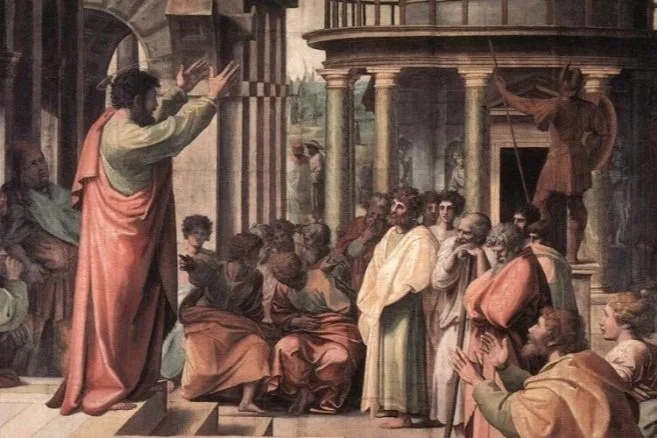
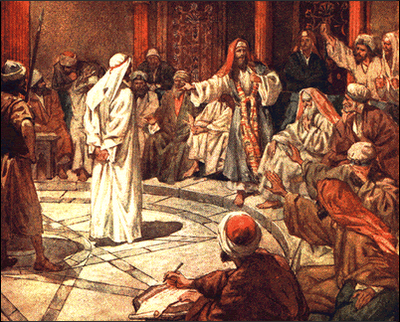
Stephen always knew that his speech before the Sanhedrin would cost him his life, yet he delivered it nonetheless. There were other ways he could have addressed the Jewish Supreme Court. He could have simply limited himself to refuting the charges leveled against him and explaining the specific content of his preaching. After all, it was false that he had uttered “blasphemous words against Moses and against God,” nor had he blasphemed against the Temple and the Law, as claimed by the witnesses who had been bought off by the Jews (Acts 6:11, 13). But he made no effort to soften his speech. He did not sugarcoat the truth, and what was supposed to be a self-defense turned into a fierce attack against his judges:
You stiff-necked people! Your hearts and ears are still uncircumcised. You are just like your ancestors: You always resist the Holy Spirit! Was there ever a prophet your ancestors did not persecute? They even killed those who predicted the coming of the Righteous One. And now you have betrayed and murdered him—you who have received the law that was given through angels but have not obeyed it. (Acts 7:51-53)
Neither Peter nor John spoke to the elders of Israel in such a manner. They would have met a premature death. But Stephen did. He knew that his hour had come, that God was calling him home early, and that his mission was to fertilize—with his martyr’s blood—the path that would lead to the expansion of the Church throughout Judea, Samaria, and Syria, and from there, to Asia and Europe. His life was the catalyst, the match that struck the flame—a flame that would never be extinguished. For him, that was the price of grace.
Frequently, the call of Jesus has exacted a high price from many Christians. Dietrich Bonhoeffer addresses this subject in his book The Cost of Discipleship[1], distinguishing between “costly grace” and “cheap grace.”
Cheap grace, he writes, is grace without discipleship, grace without the cross, grace without Jesus Christ, living and incarnate... Costly grace, he continues, is the treasure hidden in the field; for the sake of it a man will go and sell all that he has; it is the pearl of great price for which the merchant will sell all his wares; it is the kingdom of Christ for which a man will pluck out the eye that causes him to stumble; it is the call of Jesus Christ at which the disciple leaves his nets and follows him... this grace is costly because it costs a man his life.
It is this kind of grace of which Jesus spoke in Luke 9:23–24:
Then he said to them all: “Whoever wants to be my disciple must deny themselves and take up their cross daily and follow me. For whoever wants to save their life will lose it, but whoever loses their life for me will save it.”
If, as a church today, we are living out a comfortable and easy Christianity—if the practice of our faith presents us with no challenge or sacrifice, no discomfort or opposition—perhaps it is because the grace we are living by is a cheap grace. Perhaps it is because, like the church in Sardis (Revelation 3:1-6), we are a church with a reputation for being “alive,” yet are in fact dead.
In stark contrast to the majority of the churches in Asia Minor, Sardis had faced no trouble from the Roman authorities, nor from the Jews, nor from the idolaters in the city who worshipped the goddess Cybele, the goddess of fertility. It was a church living in peace—the peace of the dead; the peace obtained in exchange for remaining silent, for concealing the message of Christ, for being “politically correct.” It is a peace that fails to denounce sin and instead promotes a laissez-faire philosophy—that is, the attitude of letting everyone believe and do whatever they please. The Peace of the Postmodern Church.
May God have mercy upon us and help His church to awaken and to rescue what is still salvageable!